In this guide
How we picked
We focused on products you can buy in common toy and chew categories, including rubber toys, rope toys, plush toys, and edible chews. We compared materials, available sizes, intended chew strength, replaceability or refill options, and price per item or pack.
The best picks, ranked
Funny Dog With Chewed Shoe Vinyl Sticker
Benebone Wishbone Dog Chew Toy for Aggressive Chewers, Real Bacon, Medium | Durable, Supe…

Kseroo 3-Pack Indestructible Dog Chew Toys for Aggressive Chewers,30-100lbs | Bacon Flavo…

Frienhund Tough Dog Toys for Aggressive Chewers 3 Pack, Indestructible Dog Toys for Large…

SPOT Bam-Bones Plus T-Bone Dog Chew, Beef, 6in, 30-60 lb Heavy Chewers | Bamboo fiber & n…

Jeefome Tough Dog Toys for Aggressive Chewers, Dog Chew Toys for Large Dogs | Alligator D…

Apasiri Tough Dog Toys for Aggressive Chewers: Beef Flavored Long Lasting Dog Bones for L…

- For 20-80 lb breeds
- Nylon core with rubber sleeve
- Beef-flavored dual textures
Dog toys and chews solve a very real household problem: adult dogs can exert 200 to 450 pounds of bite force depending on size, and bored chewers can destroy a soft plush in under 10 minutes. If you’ve ever picked up rubber crumbs, string, or half a squeaker after breakfast, you already know why the phrase “my dog chews and eats his toys” gets searched so often.
That’s exactly why this guide to 7 Best Dog Toys and Chews in 2026 focuses on real-world use, not generic “cute toy” recommendations. You’ll learn which styles work best for heavy chewers, puppies, and dental care, how to match texture and shape to your dog’s chewing pattern, and which review red flags usually predict a wasted purchase.
Even if the ranked list is already on the page above, the hard part usually starts after the click: which of these dog toys and chews actually fits your dog’s jaw strength, chewing style, and safety needs? That’s what this article clears up.
Quick expert note: The best dog toy isn’t the toughest one on the page. It’s the one your dog will actually use consistently without shredding, swallowing, or ignoring it after one day.
What makes the 7 Best Dog Toys and Chews in 2026 worth considering for your dog?
The seven picks above cover three needs that matter most in daily use: durability, engagement, and chew satisfaction. In practical terms, that means a toy has to survive repeated gnawing, feel rewarding enough to keep your dog interested, and avoid breaking into sharp or swallowable chunks too quickly.
Several of the listed options lean into aggressive chewer use cases with dense nylon-style or reinforced chew shapes. That matters because dogs don’t all chew the same way. One dog strips edges and corners. Another braces the toy between both paws and grinds down the center for 20 minutes straight.
Here’s the simplest way to think about the seven:
- For nonstop power chewers: bone-style and wishbone-style chews usually last longer because they spread bite pressure across thicker arms and rounded ends.
- For dogs that get bored fast: multi-pack shapes can rotate better through the week, which often keeps interest higher after day 3 or 4.
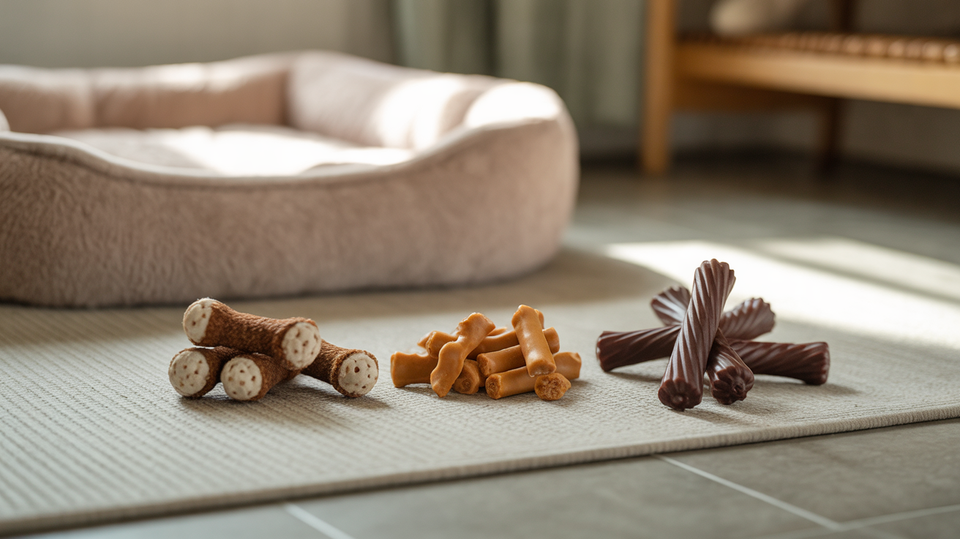
- For dogs that need oral stimulation: dog dental chews and toys with ridges, nubs, and textured channels generally do more than flat, smooth chew bars.
If your dog destroys fabric toys but loses interest in plain rubber, the most useful compromise is often a flavored, rigid chew with texture. That’s one reason bone-style chews keep showing up in top-rated heavy-duty categories year after year.
Which type of dog toys and chews work best for aggressive chewers?
For most aggressive chewers, the best starting point is a dense chew toy with thick ends, no fabric seams, and no glued-on parts. Thin protrusions, soft latex, and stuffed cores fail first because repeated side-jaw pressure creates splits long before the toy looks destroyed from the outside.
From the products listed above, the most relevant categories are:
- Wishbone-style chews
- Best for dogs that grip with both front paws
- Easier for medium and large dogs to hold steady
- Usually wears down evenly instead of cracking in one spot
- T-bone or bone-style rigid chews
- Better for straightforward gnawers that work one end at a time
- Often last longer in crate time or solo chew sessions
- Usually give stronger resistance than flexible toys
- Multi-pack tough chew toys
- Useful if your dog loses interest in a single shape
- Helps you rotate textures and chewing angles
- Often better value in the mid-range budget bracket
The Benebone Wishbone Dog Chew Toy for Aggressive Chewers style works especially well for dogs that like leverage. Meanwhile, a denser straight bone or T-bone shape can be a better match for dogs that plant the toy and grind.
7 Best Dog Toys and Chews in 2026 by budget: what actually changes as you spend more?
You don’t always get safer or more durable dog toys and chews just by spending more. What you usually get is thicker material, more complex shaping, stronger flavor retention, or multi-pack variety.
Best dog toys and chews under the lower budget range
At the low end, you’re usually choosing between a single rigid chew or a novelty item. This range can still work well if your dog is a moderate chewer, but it’s also where disappointment happens most often because slim profiles wear out fast.
Look for:
- One-piece construction
- Rounded edges instead of thin fins
- At least one textured zone for grip
- A shape your dog can brace between the paws
This is also where novelty items like the Funny Dog With Chewed Shoe Vinyl Sticker fit in. It’s obviously not a chew solution, but it’s a reminder that many owners are shopping after repeated chewing damage in the home.
The mid-range sweet spot for 7 Best Dog Toys and Chews in 2026
This is usually the smartest bracket for most households. You’ll often find better geometry, more material density, and two- or three-piece sets that let you rotate toys before your dog gets bored.
Good mid-range value typically includes:
- 2 to 3 different chew shapes
- Better thickness at stress points
- Flavor or scent built into the material
- Sizing better matched to dogs in the 30-100 lb range
The Kseroo 3-Pack Indestructible Dog Chew Toys for Aggressive Chewers and Frienhund Tough Dog Toys for Aggressive Chewers 3 Pack style of set can make more sense than one premium chew if your dog needs variety to stay engaged.
Premium-range dog toys and chews: who should actually buy them?
Premium options usually make the most sense for dogs that chew daily for long sessions. If your dog only chews for 5 minutes and walks away, a heavy-duty premium toy may be overkill.
Spend up if your dog:
- Destroys standard chews in under a week
- Needs longer solo engagement during work hours
- Has a history of targeting furniture, shoes, or crate trays
- Responds better to dense, flavored materials than to rubber bounce toys
That’s where something like the Apasiri Tough Dog Toys for Aggressive Chewers or Jeefome Tough Dog Toys for Large Dogs category becomes easier to justify.
What should you look for before buying dog toys and chews?
If you only use one checklist from this article, use this one. The best buying decisions usually come down to size, material, texture, and wear pattern.
- Match the toy to your dog’s weight range A chew designed for a 30-pound dog can become a swallowing risk for an 80-pound dog. If the listed range tops out below your dog’s weight, skip it.
- Choose rigid material for destructive chewers Soft foam, plush, and thin rubber work for gentle play but not for repeated gnawing. Heavy chewers usually need dense nylon-like or reinforced composite material.
- Check for textured surfaces Raised ridges and grooves matter because they increase grip and improve chew satisfaction. They also make dog dental chews and toys more useful for reducing surface buildup on teeth.
- Avoid narrow ends and decorative weak points Ears, tails, wings, and thin handles are often the first failure points. A toy with a uniform, thick profile generally lasts longer.
- Buy the right shape for your dog’s chewing style Dogs that pin toys with both paws often do best with wishbone or Y-shaped designs. Dogs that mouth one end repeatedly usually prefer straight bone or T-bone profiles.
- Replace at the wear threshold, not after total failure Once the edges become sharp or chunks start separating, the toy is done. Waiting for complete breakage is how swallowing accidents happen.
Pro tip: If a chew toy fits entirely behind your dog’s back molars, it’s too small for unsupervised use. That simple test catches a surprising number of bad size matches.
My dog chews and eats his toys — what should I do first?
If your first thought is, “my dog chews and eats his toys,” stop using plush, rope, or thin-latex toys unsupervised right away. Swallowed fabric strands and torn chunks are far more likely to create digestive trouble than surface-shaved bits from a properly sized rigid chew.
Start with these fixes:
- Remove toys with stuffing, fabric seams, or loose squeakers
- Offer one properly sized rigid chew during supervised sessions
- Rotate 2 to 3 toys instead of leaving 8 on the floor
- End the session if pieces begin flaking off in chunks
- Increase physical activity if destruction spikes in the evening
Dogs often shred more aggressively during the 6 p.m. to 9 p.m. window, especially if they’ve been understimulated all day. In that case, the issue isn’t just the toy — it’s timing, boredom, and pent-up energy.
If you want a useful comparison mindset, the same “right tool for the environment” logic applies in unrelated buying guides too, whether you this left handed golf grip trainer guide or evaluate home safety tech through smart smoke and co detector explained. Fit matters more than hype.
Are dog dental chews and toys actually worth it?
Yes — if the toy has real texture and your dog uses it regularly. A smooth plastic chew that gets ignored does less for oral health than a ridged chew your dog works on for 15 minutes four times a week.
The best dog dental chews and toys usually have:
- Raised nubs or grooves
- Multiple chewing angles
- A shape that stays stable between the paws
- Enough resistance to encourage longer sessions
- Size options that fit the dog correctly
💡 Did you know: Plaque can begin mineralizing into tartar in as little as 24 to 72 hours. A textured chew won’t replace brushing, but it can reduce buildup between cleanings if your dog uses it consistently.
Bone-shaped chews with ridges often outperform perfectly smooth bars here. That’s because friction matters, and friction only happens if the dog keeps chewing.
What the reviews usually reveal about the 7 Best Dog Toys and Chews in 2026
Patterns show up fast in this category. Owners tend to report the same three problems over and over: the toy was too small, the material was too soft, or the dog lost interest within 48 hours.
Here’s what typically separates a keeper from a return:
- Good signs
- Owners mention the toy lasted multiple weeks or months
- Dogs return to it without prompting
- Wear appears as surface scraping, not big chunks
- The toy works during crate time or post-walk wind-down
- Red flags
- Reviews mention flakes turning into chunks
- Dogs finish the flavor and abandon the toy the same day
- The shape is awkward for the dog to hold
- Multiple owners say it’s smaller than expected
The SPOT Bam-Bones Plus T-Bone Dog Chew type of shape often gets better comments from straightforward gnawers, while alligator or character-shaped toys can be hit or miss depending on whether decorative edges become weak spots.
You’ll see that same review-reading skill help in other pet categories too, like how cat litter and box works and even niche care gear discussed on Writeas. The principle is the same: repeated complaint patterns matter more than one glowing review.
How do you rotate dog toys and chews so your dog doesn’t get bored?
Most dogs don’t need more toys. They need fewer toys available at one time.
A simple rotation plan works better than leaving everything out:
- Day 1-2: rigid bone-style chew
- Day 3-4: wishbone or branched chew
- Day 5: textured dental chew
- Day 6: supervised novelty shape
- Day 7: rest day or revisit the favorite
This approach works because novelty resets interest. Dogs often re-engage with a toy after just 48 to 72 hours out of sight, especially if it has a scent or flavor component.
If you’re researching broader shopping habits and product comparisons, side trips like https://brain-buffet.writeas.com, read more here, or even see original show the same truth: people regret purchases less when they match use case first.
Which of the 7 Best Dog Toys and Chews in 2026 is best for your specific dog?
Here’s the fastest way to narrow the seven picks on this page.
- Best for large, relentless chewers: the densest bone-style or wishbone-style chew with thick ends and no decorative weak spots
- Best for dogs that get bored quickly: a 3-pack tough chew set with clearly different shapes
- Best for oral stimulation: a ridged chew with grooves and chew channels
- Best for dogs transitioning off plush toys: a flavored rigid chew with a familiar, easy-to-hold profile
- Best for moderate chewers: a mid-range single chew or set, rather than the absolute hardest material available
If you want one single decision rule, use this: buy for your dog’s chewing pattern, not your dog’s age alone. Two dogs of the same age and weight can destroy totally different toy types based on how they bite, hold, and grind.
Frequently Asked Questions
What is the safest type of dog chew toy for aggressive chewers?
The safest option for aggressive chewers is usually a properly sized, one-piece rigid chew toy with no stuffing, rope strands, or glued-on parts. Safety depends just as much on sizing and supervision as material, so replace the toy once it starts breaking into chunks.
How to choose dog toys and chews for a dog that destroys everything?
Start with a dense chew in the correct weight range and avoid plush, thin rubber, and rope toys for unsupervised use. The best test is wear pattern: light scraping is acceptable, but deep splits, sharp edges, or detachable pieces mean the toy is a bad match.
Are dog dental chews and toys worth buying or just marketing?
They’re worth buying if your dog actually uses them several times a week and the chew has ridges or textured surfaces. They help with surface plaque, but they don’t replace brushing or professional cleanings.
Why does my dog chew and eat his toys?
Dogs usually eat toy pieces because the material tears too easily, the toy is too small, or the dog is overstimulated and unsupervised. If my dog chews and eats his toys describes your situation, switch immediately to tougher one-piece chews and remove fabric-based toys from solo access.
How often should I replace dog toys and chews?
Replace them as soon as you see sharp edges, missing chunks, or a size reduction that could create a swallowing risk. For daily heavy chewers, that inspection should happen every few days, not once a month.